When Procurement Exists as Work, Not Leadership
Procurement doesn’t fall short because of effort. It falls short because no one at the leadership level has made it their responsibility.
In mid-market organizations, this rarely looks like neglect. Procurement is usually functioning. Orders are placed, vendors are managed, contracts get signed. But functioning and strategic are two different things. And when procurement has no defined ownership at the leadership level, the gap between them quietly widens.
That gap has a cost. Not always visible on a single invoice or within a single quarter. It appears in contract renewals nobody caught, in vendor relationships nobody managed, in spend that accumulated without anyone accountable for its direction.
Many organizations assume the solution is procurement transformation. In reality, most mid-market organizations do not need a large transformation program. They need procurement leadership.
When procurement has clear ownership at the leadership level, the function naturally evolves from operational support to strategic capability.
When Procurement Is Work, Not a Function
Operational procurement isn’t a failure. Someone has to manage the day-to-day. When procurement never moves beyond execution, the organization pays a price, often without knowing it.
Here’s what operationally stuck procurement typically looks like:
Signs Procurement Is Stuck at the Operational Level
- The procurement team is consulted after decisions are already made
- Supplier relationships are managed by whoever initiated the purchase
- Contracts are stored somewhere, but no one has visibility across them
- Savings are reported anecdotally, not measured systematically
- The Head of Procurement, if the role exists, spends most of their time on approvals and firefighting
None of these are dramatic failures. They’re the natural result of procurement being treated as process support rather than a leadership function. And they compound quietly over time.
What Procurement Leadership Looks Like in a Mid-Market Organization
In a mid-market organization, procurement leadership usually begins with something simple. Someone becomes clearly accountable for procurement outcomes.
Procurement moves from being reactive work to a function with defined ownership and a voice in business decisions. Instead of responding to requests after decisions have been made, procurement participates earlier in budgeting, supplier selection, and commercial discussions.
This shift does not require a new platform or a large program of change. It requires structural clarity about who owns procurement outcomes and how the function participates in leadership conversations.
Many organizations assume this kind of change requires a formal procurement transformation. In practice, most of the progress comes from leadership ownership. Once accountability exists, the improvements often described as procurement transformation tend to follow naturally.
What Structurally Changes in the First 12 Months
When a mid-market organization makes a genuine commitment to procurement leadership, a few things tend to change in the first year. These changes do not occur all at once, but in a recognizable pattern.
Five Things That Change When Procurement Gets Leadership
- Ownership gets assigned. Someone is specifically accountable for procurement outcomes rather than simply processing requests. This might be a fractional CPO, a promoted internal lead, or a restructured reporting relationship. What matters is that accountability is named and visible.
- Spend gets categorized. Before you can manage spend strategically, you need to understand it. Category mapping, even at a high level, creates the foundation for prioritization, supplier strategy, and negotiation leverage.
- Supplier relationships get structured. Informal supplier relationships get replaced with defined terms, performance expectations, and regular review. This doesn’t mean adversarial. It makes them professional.
- Contracts become an asset, not a filing task. A basic contract register, with renewal dates and key terms visible, immediately reduces risk exposure. It also creates the foundation for proactive renegotiation rather than reactive scrambling.
- Procurement gets a voice before the decision. The clearest signal that procurement leadership is taking hold is when procurement is brought into conversations early before decisions are finalized. This includes during budgeting, vendor evaluation, and strategic planning.
Why Procurement Leadership Often Matters More Than Procurement Transformation
One of the most common mistakes organizations make when attempting procurement transformation is introducing technology before establishing leadership accountability.
A new procurement platform won’t fix a function that doesn’t have clear ownership. Category management software won’t create strategic thinking. Supplier portals won’t replace the leadership judgment required to decide which vendor relationships actually matter.
Tools can be useful and sometimes genuinely valuable. However, they amplify what’s already there. In a function that lacks ownership and direction, tools mostly create more process without more clarity. For a deeper look at why expertise needs to come first, see Why You Need Expertise, Not Just Technology.
The organizations that see the most meaningful improvement in the first 12 months are usually the ones that started by asking a simpler question: who is accountable for this?
What Executive Accountability Looks Like
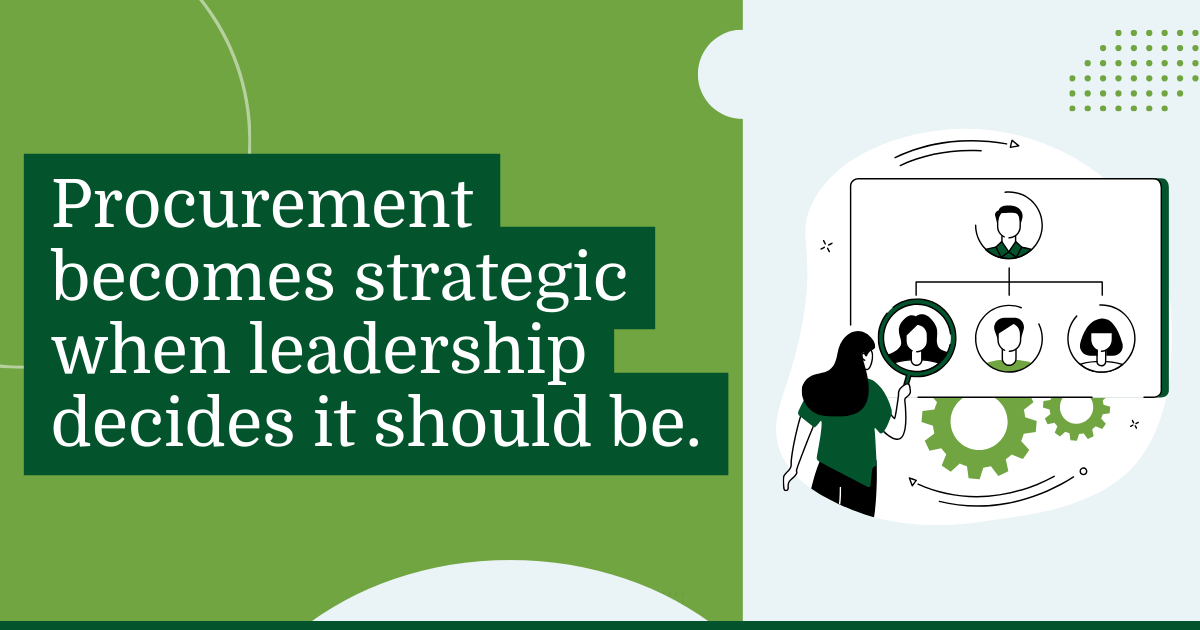
Procurement doesn’t become strategic on its own. It becomes strategic when organizational leadership decides it should be and treats procurement outcomes as a leadership responsibility. For a CFO or senior finance executive, that means more than approving a procurement budget. It means:
- Including procurement in budget and planning conversations from the start
- Setting measurable expectations for cost performance and supplier risk
- Treating contract compliance and spend visibility as governance issues, not administrative ones
- Supporting procurement when it needs to challenge a business unit or a preferred vendor
This isn’t about becoming a procurement expert. It requires recognizing procurement as an organizational capability that benefits from leadership attention.
How Procurement Leadership Reduces Cost Leakage and Risk Exposure
The financial case for procurement leadership is often framed around savings. Savings are real. Mid-market organizations that formalize procurement typically find meaningful reductions in addressable spend within the first year.
The more immediate benefit, however, is often risk reduction.
Cost leakage in operational procurement tends to come from a few consistent sources: contracts that auto-renew without review, purchases made outside of established supplier agreements, redundant vendors providing similar services at different price points, and commitments made without procurement’s involvement.
“These aren’t catastrophic individually. But collectively, they represent a pattern of organizational spend that no one is accountable for and that compounds over time.”
Procurement leadership doesn’t eliminate all of this immediately. What it creates is visibility, accountability, and the ability required to systematically managing it.
The Question Worth Asking
If your procurement function is busy but invisible, and if it processes work competently but rarely shapes decisions, the issue probably isn’t capability or effort.
It’s structure.
Mid-market organizations don’t need enterprise procurement infrastructure to close that gap. They need clarity about who owns the function, what they’re accountable for, and what support they have from leadership.
That’s a much more achievable starting point than most organizations expect.
Related Services

Fractional CPO & Interim Procurement Leadership
Procurement leadership delivered as a service — introducing coordination, commercial structure, and sourcing discipline without adding permanent headcount.

Procurement Transformation
Building the procurement function your organization actually needs — structured around leadership accountability, not just process and technology.
Ready to Move Procurement Beyond Execution?
Wolfe Procurement works with mid-market organizations to build procurement functions that operate at the leadership level, without the overhead of a full-time executive hire. A short conversation is usually enough to identify where the structural gap is and what addressing it would look like.

Andrew Wolfe
Founder & CEO | Wolfe Procurement