Over time, costs rise, leverage disappears, and alternatives go unexplored. Contracts renew automatically—often without review or negotiation. The cost of this approach is measurable.
You Don't Need to Build a Procurement Team
The good news is that you don't need to build a procurement team to get professional results.
By outsourcing key supplier projects to experienced sourcing consultants, you gain the expertise and structure—without the overhead.
In this guide, we'll cover:
- When it makes sense to outsource your RFP process
- What strategic sourcing consultants actually do
- What to expect from a professionally managed engagement
How Strategic Sourcing Consultants Support Outsourced RFP Management
Strategic sourcing consultants manage supplier selection and contract negotiations on your behalf—without requiring you to build an internal procurement department.
Think of it as fractional procurement expertise.
Instead of carrying the fixed cost of a full-time team, you engage a consultant when it matters most—on contracts where the savings potential justifies the investment.
What Strategic Sourcing Consultants Typically Provide:
Supplier Selection Services
- Identifying qualified suppliers in your category
- Pre-screening suppliers based on your requirements
- Managing the RFP process from start to finish
- Coordinating supplier presentations and demos
Vendor Evaluation Services
- Creating weighted scoring criteria
- Conducting objective proposal evaluation
- Completing a cost comparison analysis
- Performing reference checks and due diligence
Procurement Project Management
- Aligning stakeholders and gathering requirements
- Managing timelines and milestones
- Handling supplier communications and inquiries
- Supporting contract negotiation and award
Strategic Sourcing Consulting
- Developing category strategies
- Analyzing total cost of ownership
- Assessing and mitigating supplier risks
- Supporting implementation and supplier transitions
When to Engage a Strategic Sourcing Consultant for Your RFP Process
Companies often bring in strategic sourcing consultants when they face one (or more) of these challenges:
Scenario 1: The $2M Renewal Nobody Managed
+Your IT software contract is up for renewal. The supplier just sent an 8% increase—with 30 days to respond. Nobody on your team knows whether the pricing is competitive, what alternatives exist, or what leverage you have.
Without professional evaluation, you'll either accept the increase or spend hours trying to benchmark and negotiate it yourself.
A strategic sourcing consultant can benchmark market pricing, identify alternatives, run an RFP, and negotiate improved terms.
Scenario 2: The Category Beyond Your Expertise
+You need to select a supplier in a category you don't deal with regularly—IT enterprise applications, marketing services, travel, or facilities management. You've gathered 4–5 proposals, but they're structured differently and impossible to compare.
A strategic sourcing consultant who has experience in that category knows what competitive pricing looks like, what questions to ask, and which terms are negotiable. Without that insight, you're guessing—and likely overpaying.
Scenario 3: Leadership Wants Documented Cost Savings
+Your CEO or board wants measurable cost optimization across operational spend—supported by real data, not assumptions. You need formal supplier evaluation, market benchmarking, and competitive RFPs for contracts over $100K.
Strategic sourcing consultants deliver both the savings and the documentation leadership expects. Typical outcomes include 15–25% savings on renegotiated contracts—fully supported with before/after comparisons and market benchmarks.
Scenario 4: Supplier Consolidation (But You Don't Know Where to Start)
+Your AP data shows over 6,000 active suppliers, but almost 5,000 account for less than 10% of total spend. Marketing alone uses 43 different agencies—none under contract, all charging different rates for similar work.
Which suppliers do you consolidate?
A strategic sourcing consultant analyzes spend by category, identifies rationalization opportunities (for example, 43 agencies → 3), runs parallel RFPs, and negotiates volume discounts. The result: 20–30% savings and over 90% fewer supplier relationships.
When Companies Overpay
That's not an estimate; it's what the data shows when we analyze supplier contracts across industries.
Common Reasons Companies Overpay:
-
No competitive pressure
The incumbent knows you won't switch unless something breaks. -
Information asymmetry
The supplier knows their competitors' pricing; you don't. -
Scope creep
A $500K contract becomes $750K after years of add-ons nobody questions. -
Relationship bias
"Bob's a great account manager" quietly turns into "Bob's pricing is fine." -
Limited bandwidth
Finance and operations teams are too busy with core priorities to run a proper evaluation.
While opinions on RFPs vary, one fact remains: competition drives value.
The best way to create that competition—and ensure market-based pricing—is through a formal RFP process managed by someone who does this full-time.
The RFP Management Process: What Professional Supplier Selection Services Include
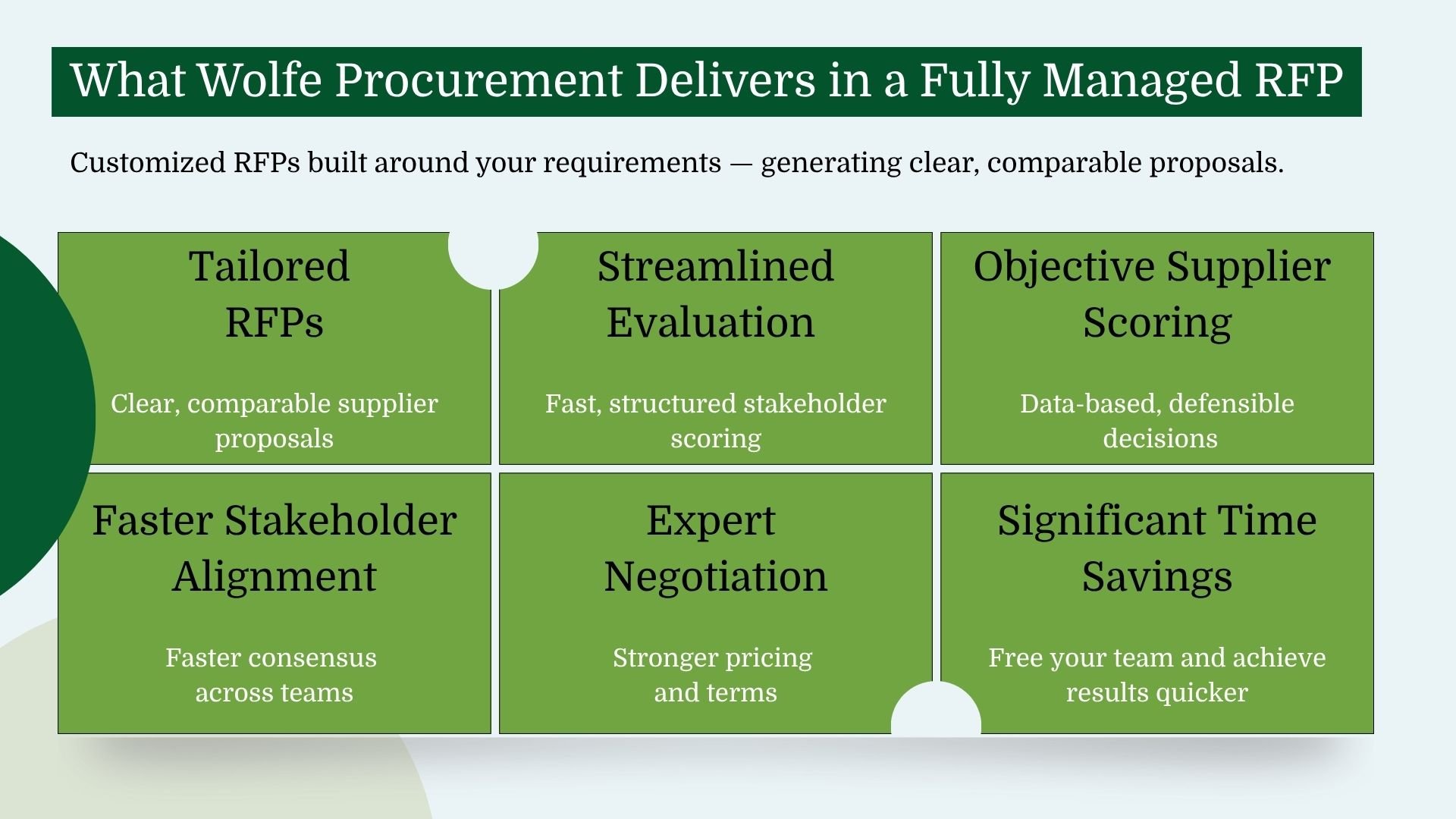
We manage the entire RFP process from start to finish through our outsourced procurement services. Our structured approach keeps projects efficient, objective, and low-risk—ensuring every supplier decision is data-driven and defensible.
What We Provide:
- Tailored RFPs – Customized documents that capture your business needs and generate comparable proposals.
- Streamlined evaluation tools – Stakeholders can review, score, and provide feedback without spreadsheet gymnastics.
- Objective supplier scoring – Weighted criteria and data-driven ratings replace guesswork and gut feel.
- Faster stakeholder alignment – Coordinated reviews bring everyone to consensus quickly.
- Expert negotiations – We handle the tough conversations while you maintain positive supplier relationships.
- Sales pressure control – We manage supplier interactions so you can explore options without sales noise or bias.
Here's How Our Procurement Project Management Process Works in Practice:
- Project Launch Assemble a cross-functional team and develop a clear project charter. Roles and responsibilities are defined early to ensure alignment and accountability.
- Define Requirements Gather detailed input from stakeholders and document procurement needs. Identify qualified suppliers that meet technical, financial, and operational criteria.
- Draft and Issue the RFP Develop a comprehensive RFP using an e-sourcing platform, clearly outlining requirements, timelines, and evaluation criteria to attract competitive proposals.
- Manage the Process and Communications Oversee the entire RFP cycle, including supplier Q&A ensuring transparency, responsiveness, and on-time delivery.
- Evaluate Proposals Establish scoring criteria and conduct an objective evaluation using our vendor assessment tools to identify the best-fit supplier(s).
- Negotiate Terms Lead structured negotiations with qualified suppliers to achieve favorable pricing, terms, and risk protection.
- Award the Contract Select the winning supplier(s) and finalize agreements that align with business goals and compliance requirements.
- Support Implementation Provide transition support to ensure a smooth rollout and supplier onboarding.


What Outsourced RFP Management Services Actually Cost
Every RFP engagement is scoped around your objectives—whether you need end-to-end RFP management, supplier evaluations, or support with negotiations. We use fixed-fee pricing tied to clearly defined deliverables, giving you full transparency and cost certainty.
For organizations without dedicated procurement resources, outsourced RFP management provides predictable, project-based costs and measurable ROI—without the overhead or complexity of hiring internally.
Frequently Asked Questions About Outsourced RFP Management Services
Companies typically outsource RFP management when they don't have an internal procurement function, lack internal resources, lack category expertise, or need an objective, unbiased evaluation. Engaging a professional sourcing partner ensures supplier competition, structured evaluation, and faster results—often within 10-14 weeks—with minimal internal workload.
Higher dollar (i.e. >$100K) or higher risk projects where companies have no or limited procurement staff to run a competitive process. Common examples include selecting a new IT enterprise application, engaging a marketing or creative agency, sourcing professional services such as HR, legal, or recruiting, and consolidating facilities, maintenance, or logistics suppliers. If you're managing high-value contracts but don't have the bandwidth or expertise for a full RFP process, outsourcing gives you access to structured procurement—without adding headcount.
Every project is priced based on scope—from managing a single supplier renewal to running a full competitive RFP. Most companies see a 3–7x return on investment within the first year through documented savings and improved contract terms. We use fixed-fee pricing for clarity and accountability. You'll know the total cost before the project starts, and our fee is always tied to measurable results.
That's exactly who we work with. We act as your on-demand procurement department—running competitive RFPs, managing supplier evaluations, and negotiating better contracts so your internal team can stay focused on core operations. You get the expertise of a procurement team without the overhead of hiring one.
Not always. In fact, a lot of our clients stay with their existing suppliers—but at better pricing and stronger terms. Often, the simple act of running a competitive process motivates incumbents to improve their offer. Switching usually makes sense only if the incumbent won't negotiate, a competitor provides stronger capabilities or better service, or there are performance or service issues. Our goal isn't to replace suppliers—it's to ensure you're getting fair market value and optimal terms.
Look for a partner who can show recent, measurable results—not just polished slides. Ask: Have they managed RFPs in the types of services you buy (IT, marketing, professional services, etc.)? Do they use a structured, data-driven evaluation process? Can they share real examples of savings and timelines? Will senior consultants actually manage your project? The right consultant should be transparent, experienced, and accountable—focused on delivering measurable outcomes, not just reports.
Ready to Stop Overpaying?
If you don't have a procurement team, we can help—whether you're exploring savings or already have an RFP to run. Most projects deliver 15–25% savings and free up your team from 100+ hours of administrative work.
Let's Start the Conversation