Procurement Spend Assessment: What's Involved and How It Works
Achieving a clear, comprehensive view of spending can be a significant challenge, especially for businesses with geographically dispersed operations or multiple lines of business.
With various systems — such as ERP, procurement, and financial platforms — operating in silos, data often becomes fragmented and disorganized across different sources. Having disparate systems or lack of consolidation makes it difficult to fully understand spending patterns and identify opportunities for cost savings.
A comprehensive spend assessment consolidates this fragmented data to reveal hidden savings opportunities — typically identifying 10-25% cost reduction potential across operational spend categories.
The Challenge: Fragmented Spending Data Across Multiple Systems

Most mid-sized companies struggle with spending visibility because their financial data lives in multiple disconnected systems. Purchase orders flow through your ERP. Corporate card transactions sit in expense management platforms. Department-level purchases happen through procurement systems. Ad hoc spending gets recorded in accounts payable.
Each system captures part of the story, but nobody has the complete picture. Finance teams spend days pulling reports from different sources, trying to reconcile the numbers, and still end up with incomplete data that’s difficult to analyze.
The result? You’re making procurement decisions without knowing what you’re actually spending, who your top suppliers are, or where your best savings opportunities exist. Year after year, cost reduction opportunities go unnoticed because the data is too fragmented to analyze effectively.
What Is a Procurement Opportunity Assessment?
A procurement opportunity assessment serves as the bridge that consolidates all this disparate source data into a single, unified report. By bringing all your spending data together, you gain the visibility needed to make informed, data-driven procurement decisions, leading to significant cost savings and financial optimization.
Unlike a simple spend report that just tells you what you spent, a procurement opportunity assessment tells you what you spent, why it matters, where the savings opportunities are, and how to capture them. It includes benchmarking against market rates, supplier consolidation opportunities, contract optimization recommendations, and a prioritized action plan.
What a Comprehensive Assessment Includes
Consolidated Spend Dashboard — A complete view of company spend organized by category, supplier, department, and business unit.
Market Benchmarking — Your pricing compared against industry standards to identify where you’re overpaying.
Prioritized Savings Opportunities — Quick wins and strategic initiatives ranked by potential impact and implementation effort.
Actionable Roadmap — Detailed implementation plan with timelines, resource requirements, and expected ROI.
Implementation Support Options — Choice to execute initiatives yourself or partner with experienced procurement consultants.
A well-executed assessment typically pays for itself many times over through savings identified in the first 90 days alone. Most organizations see a 10-20x return on investment in year one.
How a Procurement Opportunity Assessment Works
To help you get started on maximizing the value of a spend assessment, here are the key steps that guide your efforts toward better spend visibility and cost savings.
-
Step 1: Consolidate Spend Data Across All Systems
Gather financial data from all key sources such as ERP, purchase order, expense management, and corporate card systems company-wide. You’ll typically need purchase order data or accounts payable records, ERP system exports, corporate card transaction data, existing supplier contracts (if available), and any prior spend reports or category analyses. The key is working with whatever data you have and cleaning and consolidating it into a usable format.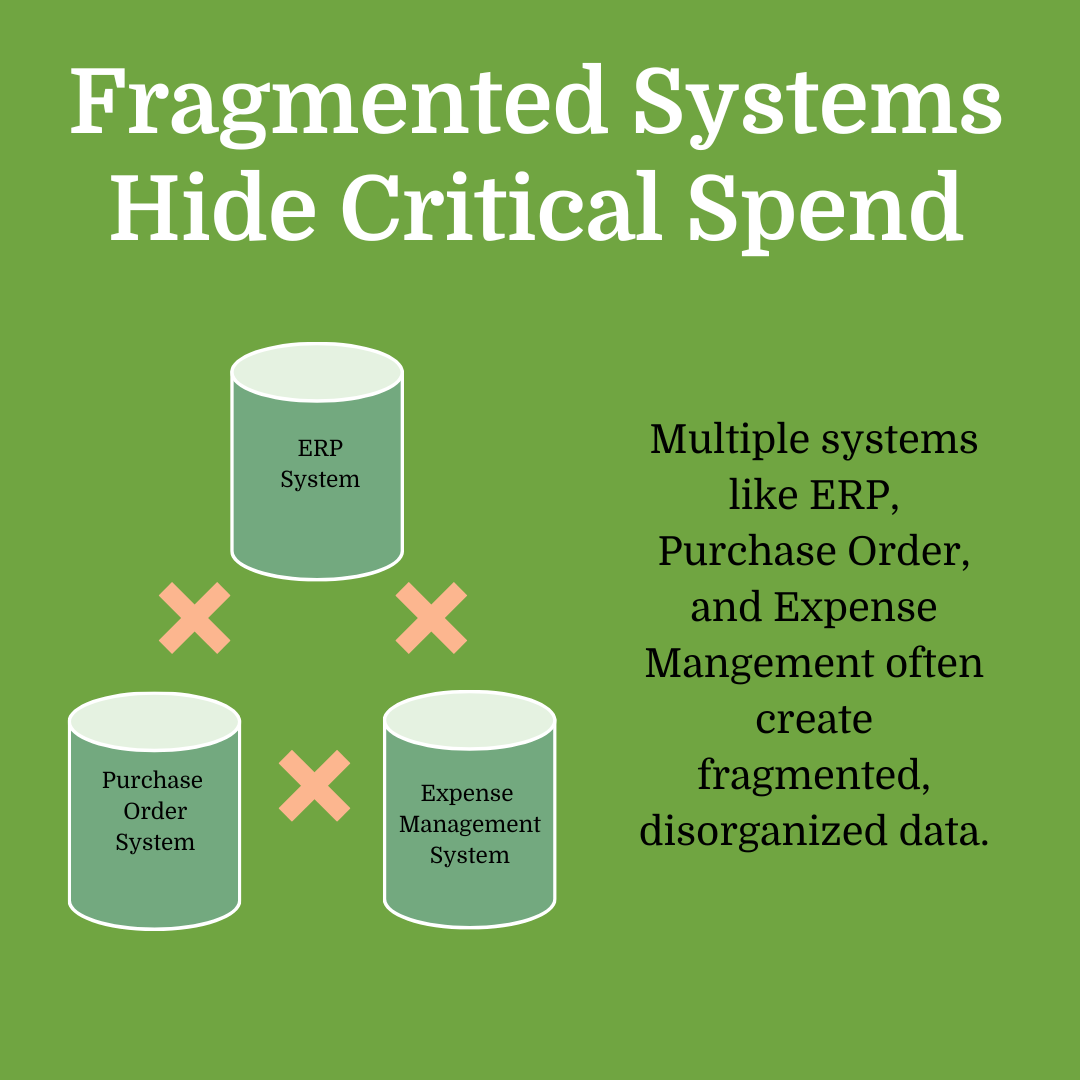
-
Step 2: Summarize Key Spend Metrics for Better Decision-Making
Once you have all your data in one place, prepare a summary that consolidates and simplifies your spending information. Revealing trends — such as total spend by category or supplier — makes it easier to identify areas of overspending and where cost-saving opportunities exist.
This analysis goes beyond surface-level reporting to uncover patterns you wouldn’t see otherwise — like multiple departments buying the same services from different vendors at different prices, legacy contracts with outdated pricing that nobody’s questioned in years, duplicate software subscriptions across the organization, or missing volume discounts because spending is fragmented. -
Step 3: Build a Cost Savings Roadmap Aligned with Financial Goals
Use the insights gained from your spend assessment to create a roadmap that outlines cost savings and optimization opportunities. The roadmap should ensure alignment with your company’s financial goals and procurement strategy to drive long-term value.
Rather than overwhelming yourself with dozens of initiatives, prioritize opportunities based on potential impact, implementation complexity, and your organizational readiness. Quick wins that deliver immediate savings should be prioritized alongside longer-term strategic initiatives that build sustainable procurement capability.
Typical Timeline for a Procurement Opportunity Assessment
What Makes This Different From a Spend Report?
Your finance team might already run periodic spend reports showing expenditures by vendor, category, or department. So why do you need a procurement opportunity assessment?
A spend report is descriptive — it tells you what happened. A procurement opportunity assessment is prescriptive — it tells you what to do about it.
What happened
“You spent $2.3M on IT services last year across 47 vendors.”
What to do about it
“You spent $2.3M on IT services, which is 18% above market rates based on industry benchmarking. By consolidating to 3-5 strategic vendors and renegotiating terms, you can reduce this to $1.8M — a $500K annual savings opportunity. Here’s the implementation roadmap.”
The assessment includes market analysis showing how your pricing compares to industry benchmarks, supplier consolidation recommendations identifying redundancy and overlap, contract optimization opportunities highlighting outdated terms and missing leverage points, and implementation guidance providing the specific steps needed to capture identified savings.
For a deeper look at what the assessment uncovers and how it drives action, see our Procurement Opportunity Assessment guide.
When to Get Help With Your Assessment
Many growing companies don’t have in-house procurement expertise — and building an internal team isn’t always the right answer. Hiring a full-time CPO and procurement team represents significant fixed cost and takes months to deliver results. Meanwhile, your operational spending continues unchecked.
If you’re unsure whether a fractional CPO is the right fit, see What is a Fractional CPO? for a practical overview of how the model works.
Procurement consulting provides an alternative approach. You get experienced expertise applied strategically where it delivers the greatest impact, without the overhead of building an internal department.
If you’re ready to get started, see How to Prepare for a Procurement Opportunity Assessment for a practical readiness checklist for leadership teams.
Related Services

Spend Assessment & Savings Roadmap
A structured analysis of organizational spend — consolidated, categorized, and prioritized to identify savings opportunities and supply chain risks.

Procurement Consulting
Fractional and project-based procurement leadership for mid-market organizations that need expertise without the overhead of a full-time hire.
Ready to Understand What You’re Actually Spending?
Wolfe Procurement conducts spend assessments and procurement opportunity assessments for mid-market organizations. Help other business leaders discover how procurement opportunity assessments can unlock hidden savings in their organizations.

Andrew Wolfe
Founder & CEO | Wolfe Procurement